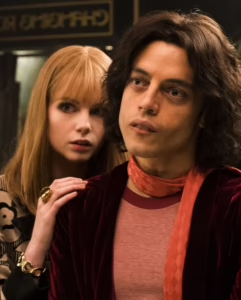
Continuing my series of newsletters exploring the emotional power of conflict, I want to further illustrate the difference between conflict and combat by examining a single, beautifully tender but heartbreaking scene in the screenplay and movie Bohemian Rhapsody.
Freddie (Rami Malek) is living in his mansion, alone, and Mary Austin (Lucy Boynton), the love of his life, lives next door. He phones her and asks her to do something for him.
FREDDIE
I want you to go to your bedroom window. Look out of it.
Freddie turns on a light and gazes up at her far away window.
FREDDIE
(cont.)
Do you see me?
MARY
Yes, I do.
FREDDIE
Now you do the same.
We see Freddie’s look of happiness as a light in Mary’s room appears. Then he asks her to have a drink with him. She tells him it’s late, but he begs her.
FREDDIE
Do you have something to drink? Go get it…. Do you have it?
MARY
Yes.
But we see that she’s lying. He toasts her and she pretends she’s raising a glass.
FREDDIE
To you, my love.
MARY
To you, Freddie.
FREDDIE
Good night.
MARY
Good night.
This scene could not be simpler or quieter. Yet it is filled with conflict – and emotion – because of the way it employs subtext.
Subtext means, in essence, “beneath the text.” It’s the underlying meaning of the action or dialogue in a story that isn’t directly written or stated.
We know Freddie and Mary love each other deeply. But because he is gay, they both realize they can never be fully together. So Freddie, filled with the alienation he has always felt, clings desperately to whatever closeness he can feel with Mary, and whatever trappings of success can numb his pain.
But none of this is stated in either the script or the movie. Neither character declares, “I love you,” or “I wish we could be together.” They never mention the pain they both feel, or the reason they can’t be together.
And their separation is represented, not just literally by the distance between their apartments, but subtextually by Mary lying to him about raising her glass. Even though Mary does what she can to avoid breaking his heart, she – and we – understand at a deeper level that she’s drifting away from him.
In this one short sequence, we see Freddie’s longing for love, connection, belonging, significance and the support of his only true friend. But the obstacles that stand in his way – his homosexuality, his inability to find peace with who he really is, and Mary’s own desire for a life of happiness and romantic love – create an abundance of conflict.
This conflict is revealed without big action, pyrotechnics, violence, fighting, or even a raised voice. With just the flick of a light switch, the raising of a single glass, and a minimum of dialogue, we experience deep, universal emotion at the pain that lies beneath.
When writing or telling your own stories, explore ALL the sources of conflict that lie between your heroes and the desires they long for. Realize that it’s often the quieter moments of action and subtextual dialogue that will touch your audiences most deeply.
In my next newsletter, I want to illustrate the impact of quiet conflict in a much shorter business related story told live from the stage.
Until that time…
Stay In Your Essence!
Michael
Read the previous articles in this series: